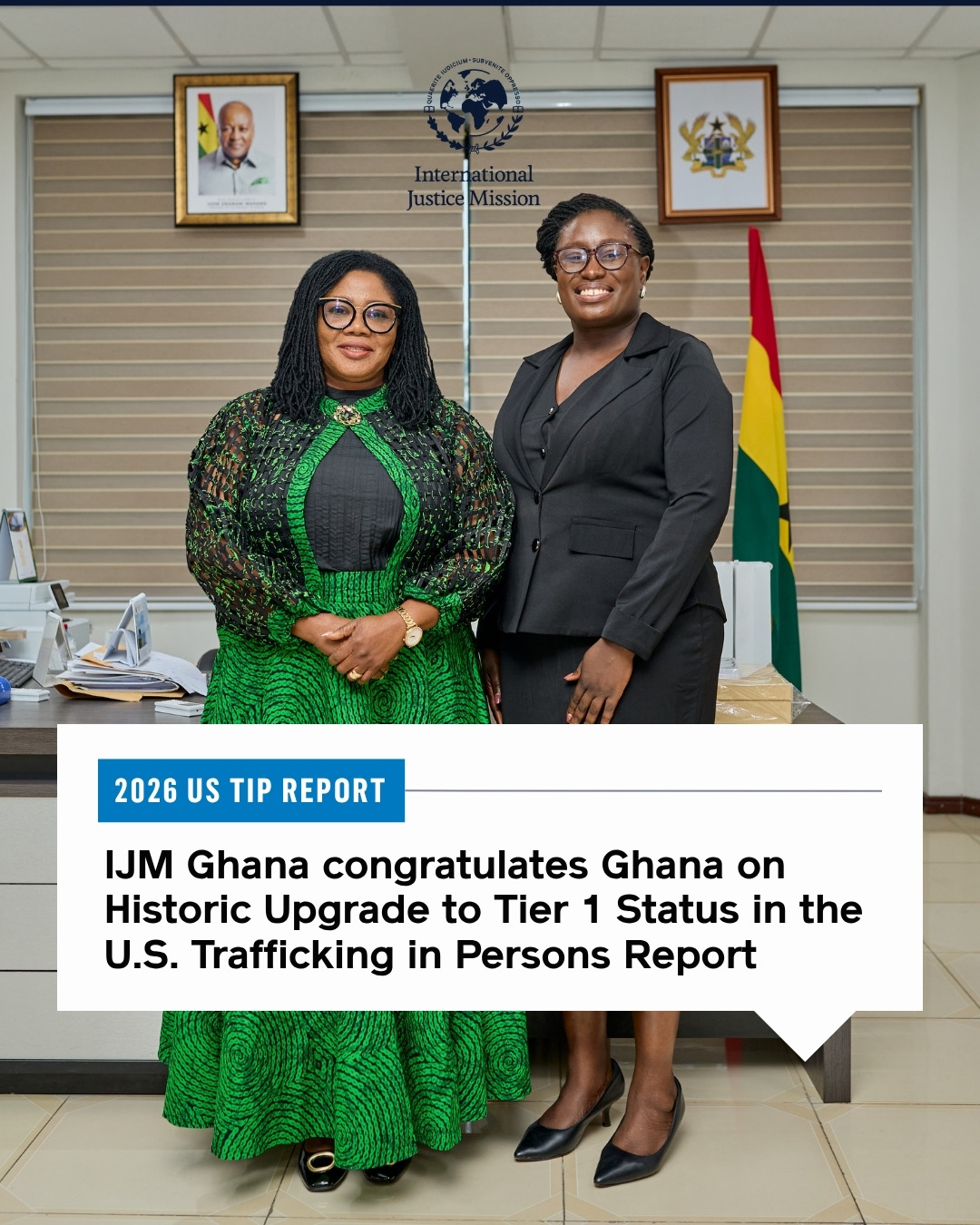
IJM Ghana Commends Ghana on Historic Upgrade to Tier 1 Status in the U.S. Trafficking in Persons Report
International Justice Mission (IJM) Ghana warmly congratulates the Government of Ghana
and all stakeholders on Ghana's upgrade from Tier 2 to Tier 1 in the United States
Department of State's Trafficking in Persons (TIP) Report. This prestigious recognition affirms
Ghana's sustained commitment and significant progress in preventing human trafficking,
protecting survivors, and prosecuting offenders.
The Tier 1 ranking signifies that Ghana fully meets the minimum standards for the elimination
of trafficking in persons. This achievement reflects years of coordinated action, strategic
investments, strengthened institutional collaboration, and the unwavering commitment of
government agencies, civil society organizations, development partners, the media, and
citizens across the country.
IJM Ghana extends its heartfelt congratulations to:
• The Ministry of Gender, Children and Social Protection (MoGCSP),
particularly the Human Trafficking Secretariat, for its leadership in coordinating
national anti-trafficking efforts and implementing Ghana's National Action Plan.
• The Office of the Attorney-General and Ministry of Justice for strengthening
prosecutions and securing increased convictions of traffickers.
• The Ghana Police Service, including specialized anti-trafficking and marine units
working to combat child trafficking and exploitation, particularly on Lake Volta.
• The Ghana Immigration Service and the Economic and Organised Crime
Office (EOCO) for their contributions to investigations, victim identification, and
efforts to tackle emerging forms of trafficking, including cyber-enabled exploitation.
• The Ministry of Labour, Jobs and Employment Relations for efforts to
strengthen labor migration safeguards and worker protections.
• Members of Parliament, especially the Select Committees on Human Rights and
Gender, for championing laws, oversight, and policies that advance the protection of
vulnerable populations.
• The National Commission for Civic Education (NCCE), media organizations,
civil society actors, faith groups, traditional leaders, and development partners whose
awareness creation, advocacy, and community engagement efforts have strengthened
prevention and protection efforts nationwide.
• Traditional and Religious leaders whose voice and influence has helped drive the
campaign.
• Most importantly, the people of Ghana, whose vigilance, reporting of suspected
trafficking, community action, and support for vulnerable children and families have
been critical to this success.
A Milestone Marked by Tangible Results
The Tier 1 ranking was driven by measurable progress across prosecution, protection, and
prevention efforts.
During the reporting period, Ghana significantly increased law enforcement action against
traffickers, prosecuting 212 alleged traffickers and securing 28 convictions, while
identifying 2,331 trafficking victims and referring all identified victims to appropriate
services. The government also increased funding for victim assistance and anti-trafficking
initiatives, expanded frontline training, strengthened international cooperation, and enhanced
efforts to combat online scam operations linked to trafficking and forced labor.
Particularly encouraging is the increase in victim identification and referral, which
demonstrates growing capacity among social welfare officers, law enforcement personnel, labor
inspectors, immigration officers, and civil society organizations working together to ensure
survivors receive the care and support they deserve.
Child Trafficking Remains a Critical Challenge
While this recognition is worth celebrating, it should also remind us that the fight against
human trafficking is far from over.
The TIP Report notes that children in Ghana continue to face exploitation in forced labor,
especially within inland and coastal fishing, domestic work, street hawking, agriculture,
artisanal mining, quarrying, and herding. Child trafficking on Lake Volta remains a significant
concern, and children from Ghana and neighboring West African countries continue to be
vulnerable to exploitation.
The report further highlights the increasing use of technology by traffickers to recruit and
exploit victims through fraudulent job offers, cybercrime schemes, online scams, and deceptive
migration opportunities.
These realities underscore the importance of sustained investments in child protection
systems, survivor-centered services, community awareness, and coordinated law enforcement
responses.
The Vital Role of Civil Society
Civil society organizations and NGOs have been indispensable partners in Ghana's anti-
trafficking journey. Throughout the reporting period, NGOs partnered with government
agencies to provide survivor care, operate shelters, conduct public education campaigns,
support investigations, build community resilience, train frontline officials, and strengthen
prevention efforts in high-risk communities.
Organizations working directly with vulnerable children, families, and survivors continue to fill
critical gaps in protection services and contribute invaluable expertise toward strengthening
Ghana's response to human trafficking.
Sustaining the Momentum
Despite the achievement of Tier 1 status, important challenges remain. Shelter capacity,
particularly for adult survivors, remains limited. Additional investments are needed to
strengthen anti-trafficking responses in rural communities, enhance specialized training on
cyber-enabled trafficking crimes, improve survivor services, and address vulnerabilities that
place children and adults at risk of exploitation.
This is the time to increasing funding for human trafficking and child protection.
IJM Ghana encourages all stakeholders not to view Tier 1 as the termination of our efforts, but
as a platform for deeper action and greater impact. Sustained progress will require continued
collaboration, adequate resourcing of frontline institutions, strengthened accountability
mechanisms, and a renewed commitment to protecting every person from violence,
exploitation, and abuse.
Reacting to this development, IJM’s Director, West Africa Programme Anita
Budu said;
"Ghana's elevation to Tier 1 status is a significant national achievement that reflects
the power of coordinated action and collective commitment. We commend the
Government of Ghana and all stakeholders whose dedication has contributed to this
milestone.
At the same time, we recognize that thousands of children and vulnerable adults
remain at risk of trafficking and exploitation. This achievement should inspire us to
work even harder to ensure every child is safe, every survivor is protected, and every
trafficker is held accountable."
About IJM Ghana
International Justice Mission (IJM) is a global organization that protects the Vulnerable and
people living in poverty from violence and exploitation. We partner with local authorities in 33
programs offices in 19 countries to combat violence against women and children, abuse of
power by public authorities, and various forms of human trafficking and forced labour.
We aim to strengthen justice systems, support survivors, and advocate for lasting change.
In Ghana, IJM partners with government institutions to address human trafficking and forced
labour in the agricultural sector, by strengthening the capacity of relevant authorities to
identify, remediate, and prevent cases.
Keep Reading